> ## Documentation Index
> Fetch the complete documentation index at: https://openlayer.com/docs/llms.txt
> Use this file to discover all available pages before exploring further.
# Security
> Learn more about our data security practices and compliance measures.
## Overview
At Openlayer, our number one priority is the security and privacy of our users' data.
Our platform is designed with best-in-class security measures to ensure your data is safe and
secure at every layer. This includes state-of-the-art encryption, safe and reliable infrastructure
partners, and independently verified security controls.
## Authentication Options
Openlayer provides multiple secure authentication methods:
* **Email and Password**: Standard authentication with strong password requirements
* **Google SSO**: Single Sign-On with Google Workspace accounts
* **SAML SSO**: Enterprise-grade Single Sign-On with your identity provider (IdP)
* **Multi-factor Authentication (MFA)**: Add an extra layer of security with authenticator apps and recovery codes
Before you log in or sign up, use the **Data region** field to choose **United States** or
**European Union**. Your account and session belong to the region you select. See
[Data regions](/docs/security/data-residency) for the regional hosts and sign-in steps.
For more information on setting up SAML SSO, including how to authenticate bot users, see our [SAML SSO documentation](/docs/security/saml-sso). To configure multi-factor authentication for your account, see our [Multi-factor Authentication documentation](/docs/security/multi-factor-authentication).
## Workspace security settings
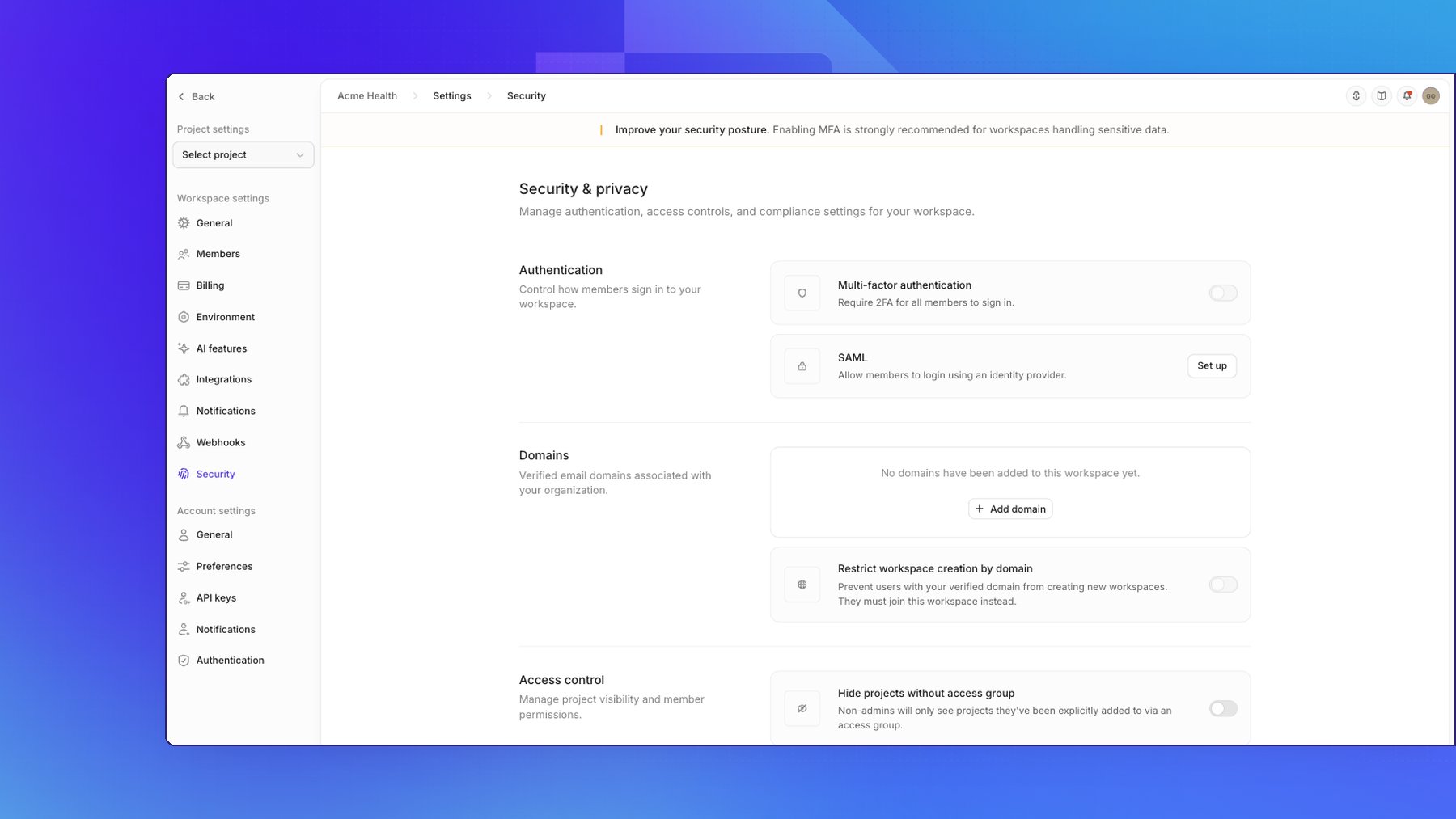
Workspace admins manage the settings below under **Workspace settings** → **Security**.
 ### Verified domains
Add the email domains your organization owns and verify them from the **Domains** section. A verified
domain tells Openlayer which email addresses belong to you, which is what the workspace creation
control below acts on.
### Restrict workspace creation by domain
Once you have a verified domain, turn on **Restrict workspace creation by domain** to stop people
with an email address on that domain from creating new workspaces of their own. They join your
existing workspace instead.
Use it to keep an organization on one governed workspace rather than a scatter of unmanaged ones.
### Hide projects without access group
Under **Access control**, **Hide projects without access group** limits non-admins to the projects
they have been explicitly added to through an [access group](/docs/security/access-groups). Admins
continue to see everything.
This is off by default, which means every workspace member can see every project unless an access
group restricts it.
### Verified domains
Add the email domains your organization owns and verify them from the **Domains** section. A verified
domain tells Openlayer which email addresses belong to you, which is what the workspace creation
control below acts on.
### Restrict workspace creation by domain
Once you have a verified domain, turn on **Restrict workspace creation by domain** to stop people
with an email address on that domain from creating new workspaces of their own. They join your
existing workspace instead.
Use it to keep an organization on one governed workspace rather than a scatter of unmanaged ones.
### Hide projects without access group
Under **Access control**, **Hide projects without access group** limits non-admins to the projects
they have been explicitly added to through an [access group](/docs/security/access-groups). Admins
continue to see everything.
This is off by default, which means every workspace member can see every project unless an access
group restricts it.
 ### Connected apps
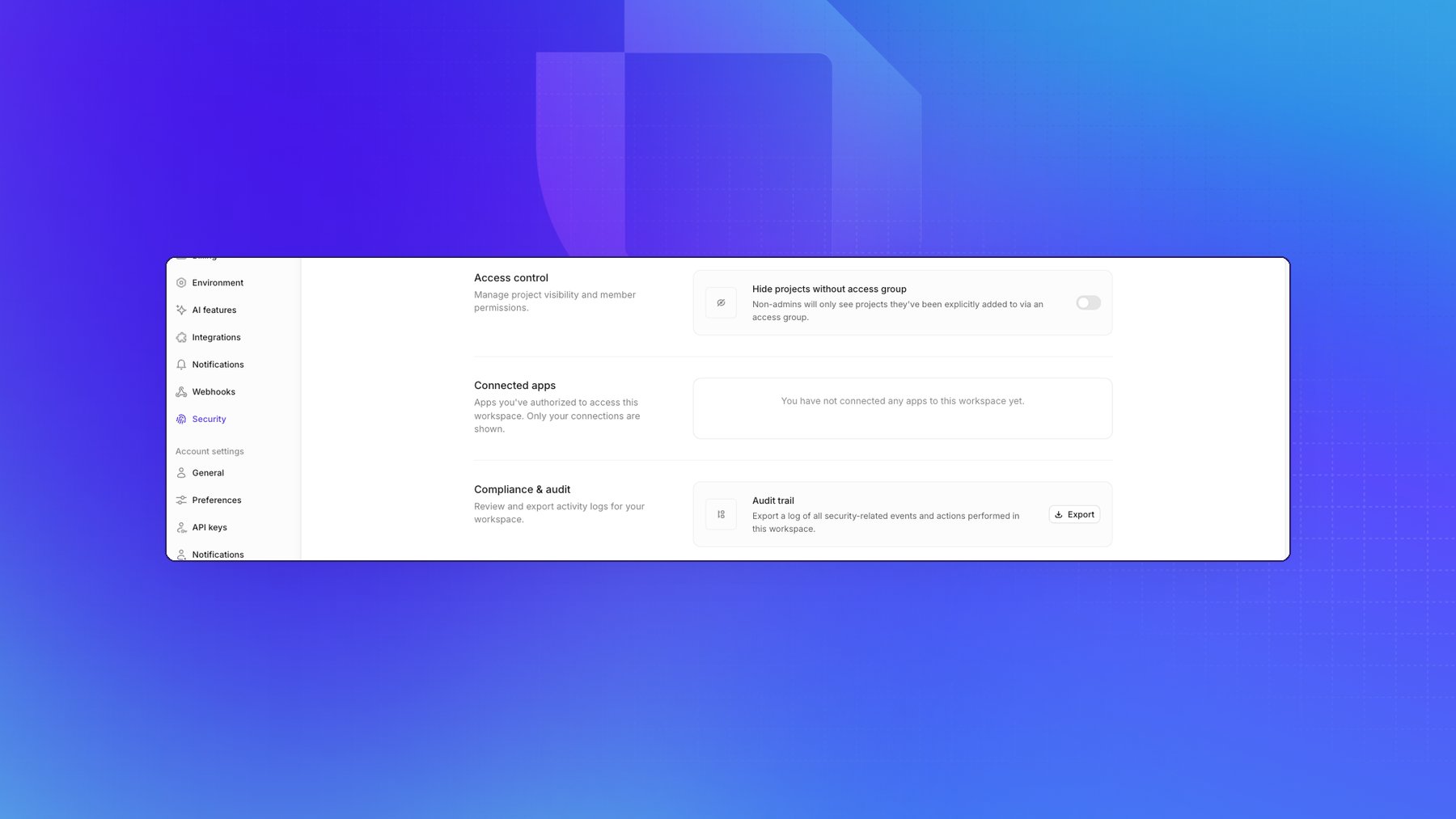
**Connected apps** lists the applications you have authorized to reach this workspace on your behalf,
such as the [Openlayer MCP connector](/docs/openlayer-mcp). Each connection is granted either full or
read-only access, and read-only caps what it can do at the level of a Viewer no matter your own role.
The list shows your own connections only. Revoke one to cut off its access immediately.
### Audit trail
Under **Compliance & audit**, **Export** produces a CSV of the security-related events and actions
performed in the workspace, optionally limited to a time range. The export runs in the background and
is available to workspace admins.
Reach for it when an auditor asks who changed what, or to review directory sync activity.
## Certifications
Openlayer is SOC 2 Type II compliant. To receive a copy of the report, email [security@openlayer.com](mailto:security@openlayer.com).
## Report a Vulnerability
You can read more about reporting any suspected security issues, what's in scope
for reports and other guidelines on our [responsible disclosure page](https://openlayer.com/disclosure).
## FAQ
We use Amazon Web Services. Openlayer offers **United States** and
**European Union** data regions. The United States data region is hosted in
AWS US West 2. Choose your region when you log in or sign up. See [Data
regions](/docs/security/data-residency) for the regional hosts and sign-in steps.
All communication outside our cloud environment is encrypted. In addition,
our databases are encrypted at rest.
Yes. Every workspace member is assigned one of four roles: **Admin**,
**Member**, **Member Restricted**, or **Viewer**. Each role grants a
different level of access, from full workspace control (Admin) to read-only
visibility (Viewer). See [Roles and
permissions](/docs/security/roles-and-permissions) for full details and a
permission matrix.
Yes, you can self-host Openlayer with a single command. Reach out to us at
[sales@openlayer.com](mailto:sales@openlayer.com) for instructions.
Yes, Openlayer supports SAML SSO with all major identity providers. This
allows your organization to authenticate users through your IdP, providing
enhanced security and a streamlined login experience. See our [SAML SSO
documentation](/docs/security/saml-sso) for setup instructions.
This documentation is built and hosted on [Mintlify](https://mintlify.com), a developer documentation platform.
### Connected apps
**Connected apps** lists the applications you have authorized to reach this workspace on your behalf,
such as the [Openlayer MCP connector](/docs/openlayer-mcp). Each connection is granted either full or
read-only access, and read-only caps what it can do at the level of a Viewer no matter your own role.
The list shows your own connections only. Revoke one to cut off its access immediately.
### Audit trail
Under **Compliance & audit**, **Export** produces a CSV of the security-related events and actions
performed in the workspace, optionally limited to a time range. The export runs in the background and
is available to workspace admins.
Reach for it when an auditor asks who changed what, or to review directory sync activity.
## Certifications
Openlayer is SOC 2 Type II compliant. To receive a copy of the report, email [security@openlayer.com](mailto:security@openlayer.com).
## Report a Vulnerability
You can read more about reporting any suspected security issues, what's in scope
for reports and other guidelines on our [responsible disclosure page](https://openlayer.com/disclosure).
## FAQ
We use Amazon Web Services. Openlayer offers **United States** and
**European Union** data regions. The United States data region is hosted in
AWS US West 2. Choose your region when you log in or sign up. See [Data
regions](/docs/security/data-residency) for the regional hosts and sign-in steps.
All communication outside our cloud environment is encrypted. In addition,
our databases are encrypted at rest.
Yes. Every workspace member is assigned one of four roles: **Admin**,
**Member**, **Member Restricted**, or **Viewer**. Each role grants a
different level of access, from full workspace control (Admin) to read-only
visibility (Viewer). See [Roles and
permissions](/docs/security/roles-and-permissions) for full details and a
permission matrix.
Yes, you can self-host Openlayer with a single command. Reach out to us at
[sales@openlayer.com](mailto:sales@openlayer.com) for instructions.
Yes, Openlayer supports SAML SSO with all major identity providers. This
allows your organization to authenticate users through your IdP, providing
enhanced security and a streamlined login experience. See our [SAML SSO
documentation](/docs/security/saml-sso) for setup instructions.
This documentation is built and hosted on [Mintlify](https://mintlify.com), a developer documentation platform.